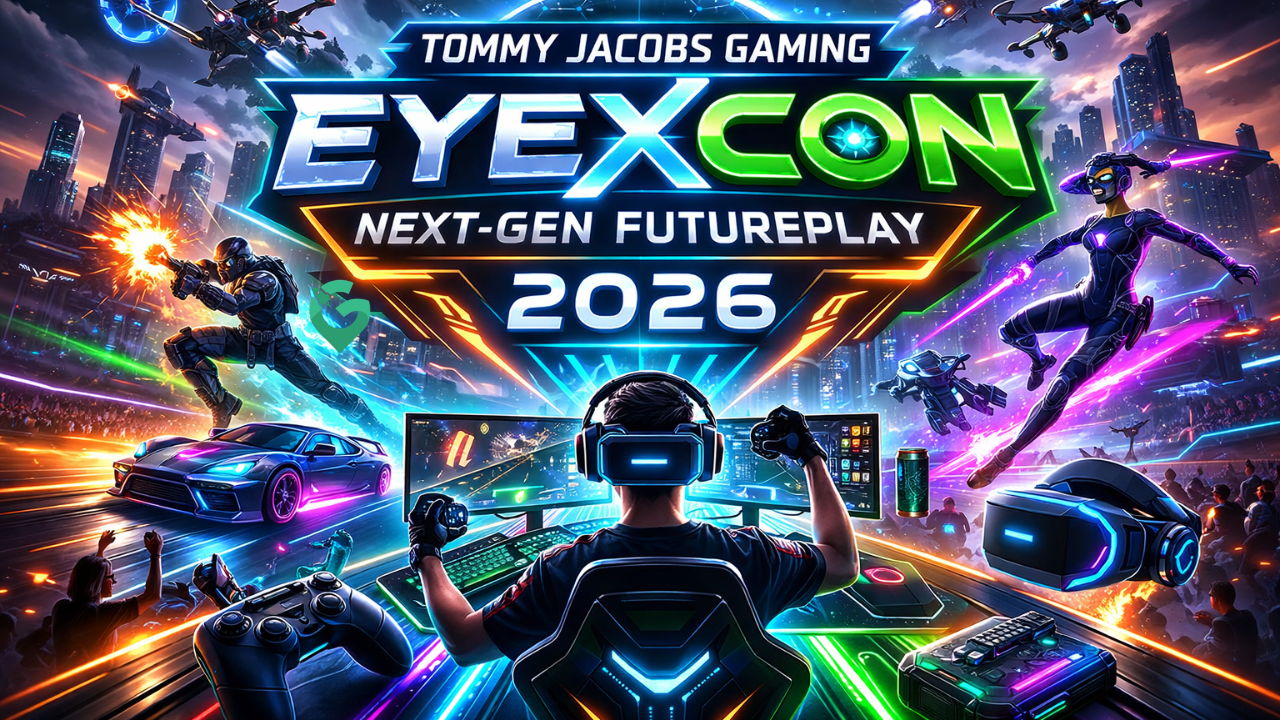
Tommy Jacobs Gaming EyeXcon: Next-Gen FuturePlay 2026
Why “Tommy Jacobs Gaming Eyexcon” is suddenly popping up everywhere
Searches for “Tommy Jacobs gaming eyexcon” are climbing fast because the phrase looks like a single, polished brand name. But online, it’s being used more like a mashup of concepts: a creator identity (“Tommy Jacobs”) paired with a broad umbrella label (“EyeXcon”) that different writers describe in totally different ways.
On some pages, EyeXcon sounds like a gaming convention—workshops, demos, meetups, creator networking, and community programming. On other pages, it’s presented like a vision-focused gaming technology stack centered on eye tracking, training, and immersive interaction.
That split matters. It doesn’t automatically mean the whole thing is fake. Still, it does mean you should be cautious with “hard” claims—like ultra-high refresh rates, “thousands of supported titles,” or sweeping compatibility promises—unless they’re backed by something verifiable (an official spec sheet, major outlet coverage, or a credible technical demo). Right now, a lot of the pages ranking for the term reuse similar language and big-number promises without linking to primary documentation.
What EyeXcon appears to represent in 2026: event + vision tech, blended
Across what’s circulating, two versions of EyeXcon keep repeating:
- EyeXcon as a convention format
A hands-on, creator-forward gathering: learning sessions, esports, indie showcases, mentorship-style programming, and access that feels more “community” than “corporate expo.” - EyeXcon is vision-first gameplay
A direction where gaze tracking becomes a meaningful input layer (and sometimes a training signal) affecting aiming, camera control, attention-based mechanics, and streamer coaching overlays.
Those two ideas complement each other. A convention is a natural place to demo and teach new interaction tech, and the tech can become the “signature” identity that differentiates the event. So the most coherent read of “Tommy Jacobs Gaming Eyexcon” in 2026 is: a brand narrative tying a creator identity to gaze/vision-centered gaming—expressed both as a community event and as a tech-forward gameplay style.
The real tech under the hype: eye tracking in gaming is already a thing
Even if some EyeXcon pages overstate specifics, eye tracking itself is very real and already used in consumer gaming. Companies like Tobii have marketed eye + head tracking for gameplay and immersion, and eye tracking has long been used in accessibility contexts to enable people to control computers (and play games) using gaze.
So when someone says “your eyes become the controller,” the core idea isn’t science fiction. The real question is whether EyeXcon-branded promises (rates, platforms, “universal support,” huge title lists) are documented, reproducible, and independently confirmed.
Where “FuturePlay 2026” actually makes sense: attention-aware design
The strongest believable “FuturePlay 2026” angle isn’t “controllers are dead tomorrow.” It’s adding a layer of intent.
Eye tracking answers a powerful design question games have always guessed at: what are you looking at right now? That enables features that can feel subtle but smart:
- UI that gets out of the way until you need it
- hints that appear only when you’re actively searching
- adaptive difficulty based on what you’re missing
- spectator tools showing how top players scan scenes
- creator overlays like gaze heatmaps and post-game attention analytics
This is also where the “Tommy Jacobs” creator tie-in fits neatly: streamers love turning invisible skill into visible proof. A gaze overlay can transform “trust me, I saw it” into “here’s exactly what my eyes prioritized.”
Esports + training: what’s plausible vs. what needs evidence
Many write-ups frame this as a performance system that blends vision science, esports training, and optimized hardware. That’s plausible in concept: competitive play is deeply connected to visual search, attention control, and reaction cues—and eye tracking can measure those patterns and help players self-correct (minimap checks, tunnel vision, target acquisition habits, etc.).
But a good line to draw as a reader is:
- Training insight is believable.
- Guaranteed competitive advantage is not.
Eye tracking can reveal what you do, but it doesn’t magically replace game sense, teamwork, or strategy. Plus, real-world implementation has friction: calibration, lighting, glasses compatibility, drift, and performance overhead can all affect how good it feels.
Accessibility: the most meaningful “next-gen” outcome
If EyeXcon becomes anything lasting, the most valuable direction is accessibility-first design.
Eye-gaze control can be the difference between “can’t play” and “can play” for people with limited mobility. And accessibility improvements often make games better for everyone: cleaner UIs, better assist options, and more flexible control systems. If “Tommy Jacobs gaming eyexcon” is positioned as a 2026 movement, tying it to inclusive play (tryout stations, workshops, developer guidance, mentorship) makes it feel like more than a gadget headline.
The “is it real?” question: how to verify without getting fooled
Right now, the term’s footprint is heavily boosted by smaller posts that repeat similar themes, plus general “Eyexcon” style hub content rather than a single unmistakable official portal with concrete specifics.
A simple verification checklist helps:
- Official event proof: venue, dates, organizer/legal entity, ticketing partner
- Official product proof: spec sheet, supported platforms list, SDK docs, privacy policy (biometric data handling matters here)
- Independent coverage: established gaming/tech outlets, conference listings you can verify elsewhere
- Hands-on demos: calibration shown, real gameplay integration, measurable latency, reproducible tests
Until those exist, it’s safest to treat EyeXcon as a concept label borrowing credibility from real eye-tracking tech, rather than a fully confirmed product line or verified convention with locked details.
The safest way to describe it without overclaiming
A defensible framing is:
“Tommy Jacobs Gaming EyeXcon” is an emerging online concept that blends community-driven gaming culture (creators, events, esports) with gaze-based interaction and vision-performance training—mirroring how the currently ranking pages describe it, without asserting unverified specs as fact.
Goten
What to watch for next in 2026
If EyeXcon evolves from keyword into a real-world thing, the signs will be concrete:
- partnerships with recognizable hardware makers
- An SDK developer can actually download
- transparent biometric/privacy handling
- a supported-games list that users can reproduce
- verifiable schedules, sponsors, exhibitor lists, and locations (if it’s an event)
Until then, the most interesting takeaway is still true: gaming is moving toward more immersive interfaces, more measurable coaching tools, and (hopefully) more inclusive ways to play—whether or not “Tommy Jacobs Gaming Eyexcon” ends up being the name that sticks.