

Why “Quiet Ambition” is the New Student Trend: Success Without the Burnout
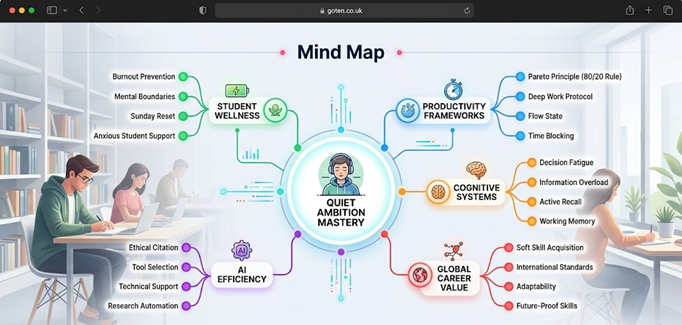
For decades, “Hustle Culture” was the undisputed king of the campus. Students were told that success was a product of sleepless nights, caffeine-fueled study binges, and a schedule packed so tight there was no room to breathe. But as we move further into 2026, a massive shift is occurring. There is a new philosophy taking over dorm rooms and lecture halls across the globe: Quiet Ambition. This isn’t about a lack of drive or a desire to do nothing; it is about a radical refusal to let academic pressure dictate one’s entire identity. It is the art of being high-achieving while remaining low-stress, choosing meaningful progress over performative busyness.
The rise of Quiet Ambition is largely a response to the “Always-On” digital era. Today’s students have realized that a high GPA isn’t worth a mental breakdown. Instead of trying to do everything at once, they are applying a business-like efficiency to their studies. They use advanced productivity frameworks to identify which tasks require their full creative energy and which ones can be streamlined or delegated. For instance, a student focusing on a complex software engineering degree might realize their time is better spent mastering system architecture rather than struggling with repetitive syntax errors; in such cases, many turn to strategic resources for programming assignment help at myassignmenthelp to keep their project timelines on track without sacrificing their sleep or sanity.
The Anatomy of the Quietly Ambitious Student
To understand this trend, we must look at the “Value-System” shift. The old model of the “Grinder” student prioritized volume: more hours, more pages, more stress. The “Quietly Ambitious” student prioritizes Systemic Output. They view their degree as a project to be managed, not a identity to be consumed by.
| Feature | The Old “Hustle” Model | The New “Quiet Ambition” Model |
| Primary Goal | Perfect grades at any cost | Sustainable excellence & high ROI |
| Study Method | Rote memorization & “All-Nighters” | Active recall & Spaced Repetition |
| Tool Usage | Manual labor for every task | Strategic automation & Outsourcing |
| Mental State | Chronic anxiety & Burnout | Flow state & Intentional rest |
| Social Life | Sacrificed for the library | Integrated as a “Mental Reset” |
The Science of Cognitive Load: Why Less is More
To understand why Quiet Ambition works, we have to look at how our brains process information. Every decision we make—from what to eat for breakfast to how to structure a thesis—consumes a portion of our limited mental energy. This is known as Cognitive Load. When a student tries to juggle five different subjects, a side hustle, and a social life without a filter, they hit a state of “Decision Fatigue.” This is where burnout begins.
The “Quietly Ambitious” student operates on the Pareto Principle, also known as the 80/20 rule. They understand that 80% of their academic results actually come from just 20% of their efforts. By identifying that “Vital Few”—the core concepts, the major exams, and the networking opportunities—they can let go of the “Trivial Many.” This approach allows them to maintain a 4.0 GPA while still having time for a three-day weekend or a midday gym session. It is about working with the brain’s natural rhythms rather than fighting against them.
Historical Perspective: Breaking the “Exam” Cycle
Many students feel guilty when they aren’t suffering for their grades because the traditional education system was designed to equate struggle with learning. When we look at the origins of standardized testing, it’s interesting to see how the system was built to rank and file students rather than purely educate them. If you’ve ever sat in a library at 3:00 AM wondering who invented exams, you might be surprised to find that Henry Fischel is often credited with the concept in the late 19th century as a way to measure a student’s “fitness” for a profession. However, in 2026, students are questioning whether a 19th-century metric still applies to a world driven by creativity and AI.
Redefining Success: The Three Pillars of Quiet Ambition
If Quiet Ambition isn’t about laziness, what is it actually made of? It rests on three specific pillars that separate it from the old way of doing things:
1. Strict Boundaries and the “Hard Stop”
The “Quietly Ambitious” student has a “Hard Stop” time. At 6:00 PM, the books are closed. The laptop is shut. This allows the brain to enter “Diffuse Mode,” where it subconsciously processes information while the student is doing something else, like walking or cooking. Research shows that our most creative breakthroughs happen when we are not actively thinking about the problem. By creating boundaries, students actually become more brilliant.
2. Intentional Outsourcing
Just as a CEO wouldn’t spend four hours doing their own payroll, a modern student doesn’t spend ten hours on a bibliography or basic data entry. They use tools and expert services to handle the administrative side of academia, allowing them to focus on the high-level critical thinking that actually matters. This is the hallmark of a “Strategist” rather than a “Worker Bee.”
3. Outcome Over Activity
Success is measured by the quality of the final project, not the number of hours spent in the library. If you can finish a high-quality essay in two hours using a deep-work protocol, why spend eight? This generation values time as their most precious currency.
Managing the “Dopamine Loop” and Digital Distraction
One of the biggest hurdles to achieving success without burnout is the modern dopamine loop created by social media and instant notifications. Traditional students often “procrastinate-work,” which means they sit at their desks for hours but spend half that time scrolling through feeds. This creates a state of constant, low-level stress—you aren’t working, but you aren’t relaxing either.
Quietly Ambitious students practice Dopamine Detoxing. They treat their focus as their most valuable asset. When they work, they are 100% “in.” When they play, they are 100% “out.” This binary approach prevents the “gray area” of productivity where you are neither working effectively nor resting deeply. By reclaiming their attention spans, they find that academic tasks that used to take all day can be finished in a fraction of the time.
The Role of Academic Partnerships in 2026
In this new landscape, the relationship between a student and their resources has changed. Education is no longer a solo mountain climb; it’s a collaborative project. Utilizing an academic partner is no longer seen as a “shortcut,” but as a smart management strategy. Whether it’s getting a second pair of eyes on a dissertation or using a service to help navigate complex engineering problems, these partnerships are the “Secret Sauce” of the high-achieving, low-stress student.
This model mirrors the professional world. In high-level corporate environments, leaders delegate specialized tasks to experts to ensure the highest quality of the final product. Why should university be any different? By partnering with experts, students ensure their technical work is flawless while they focus on mastering the concepts.
The Global Tone of Modern Education
Quiet Ambition is a global movement. From the competitive universities in Singapore to the creative hubs in London and the tech-centric campuses in Silicon Valley, students are speaking a new language. They are looking for a “Global Tone” in their work—writing that is professional, clear, and inclusive. They understand that to succeed in a remote-first, international job market, they need to communicate effectively across borders.
To achieve this, many students seek out professional editing and writing assistance to ensure their tone matches the high standards of global academic journals. This isn’t just about passing a class; it’s about building a portfolio that stands up to international scrutiny.
Why “Quiet Ambition” is the Future of Higher Education
The world is changing. Employers are starting to value “Soft Skills” like emotional intelligence, time management, and adaptability over raw technical knowledge that can be handled by AI. A student who spends four years in a state of chronic burnout arrives at their first job exhausted, cynical, and lacking the soft skills needed for leadership.
A student who practices Quiet Ambition arrives energized, with a toolkit of productivity systems that will serve them for the rest of their career. They have learned how to manage stress, how to delegate, and how to prioritize. These are the real-world skills that matter.
As we look toward the future, the “Quiet Ambition” trend will likely become the standard. We are seeing a generation that refuses to accept that “suffering for your craft” is a requirement for success. By focusing on mental health, leveraging modern support systems, and prioritizing results over the appearance of hard work, students are finally proving that you can reach the top of the mountain without losing yourself along the way. Success is no longer measured by the depth of your exhaustion, but by the height of your impact and the peace of your mind.
Frequently Asked Questions
What exactly is “Quiet Ambition” in a university setting?
It is a shift in mindset where students prioritize sustainable systems and mental well-being over the traditional “hustle” culture. Instead of seeking success through exhaustion, students focus on high-impact results and setting firm boundaries between their studies and personal lives.
How does this approach prevent academic burnout?
By applying the Pareto Principle, students identify the 20% of tasks that drive the majority of their grades. By focusing their peak energy on these areas and streamlining or delegating administrative and repetitive tasks, they reduce the chronic stress associated with a constant, heavy workload.
Does seeking external support conflict with academic integrity?
Not when used as a strategic learning tool. High-achieving students use professional resources for research assistance, complex data navigation, and high-level editing to enhance their understanding and ensure their final output meets global professional standards.
Can “Quiet Ambition” actually lead to better career prospects?
Yes. Employers in 2026 increasingly value emotional intelligence, time management, and the ability to delegate over raw technical endurance. Students who master these efficiency-based systems arrive in the workforce more energized and better prepared for leadership roles.
About The Author
Ella Thompson is a dedicated digital content strategist and researcher specializing in academic productivity and modern learning systems. With a focus on sustainable success and mental well-being, she currently contributes expert insights and educational resources for MyAssignmentHelp. Based in the UK, Ella is passionate about helping students navigate the complexities of higher education through high-level organizational strategies and efficient workflow management.